My Baby’s Temperature

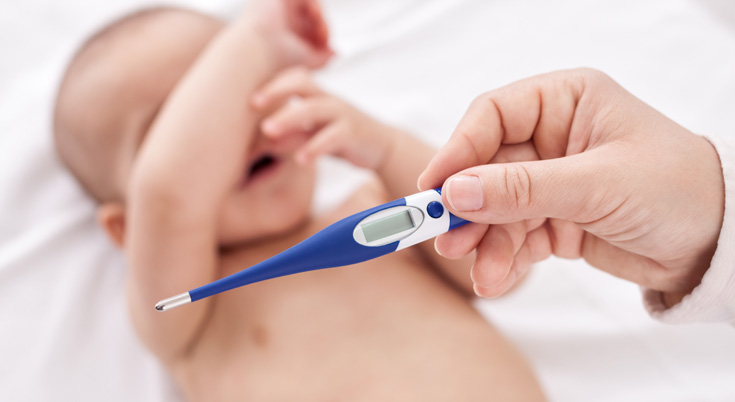
As a parent, you may experience being worried and clueless on what to do upon seeing your baby flushed, hot, and sweaty. Your baby’s forehead feels a sudden rise in heat. You immediately suspect a fever, but are unsure of what to do next. “Should I get the thermometer? Call the doctor?” If your infant is healthy, fever usually don’t indicate anything serious. Be more cautious with a young baby (under six months) as feverish illness is quite unusual and could be more serious.

baby temperature

My Baby’s Temperature

The baby’s temperature will help you to have an idea about the range of possible body temperatures your baby may have what they can mean and what you may be able to do.

Here’s more about baby’s temperature, how to measure and treat them when it is beyond the range, and when to call your doctor.

What is a normal baby temperature?

Normal: For a baby (or child or adult), it is normal to have a body temperature of about 36 to 37 degrees Celsius (or about 96.8 to 98.6 degrees Fahrenheit). Lower than 36 degrees Celsius (or 96.8 degrees Fahrenheit) means that your baby needs to be ‘warmed up’.

Low grade temperature: If it is between 37 to 37.5 Celsius (or 98.6 to 99.5 Fahrenheit). This is not regarded as a fever, but may be caused by your baby being overexposed to the sun, overheated, overdressed, being over-wrapped, or being in a hot a closed environment (room, car, etc.), particularly in a warm weather.
If this occurs to your baby and there are no other physical signs of infection, then it is likely to have some clothes or bedding taken off. Take off any heavy or thick clothing, only place a sheet or light cover over them when sleeping. If their temperature comes down, then nothing else required

High grade fever: Doctors usually say a baby has a fever if the temperature rises to 38 degrees Celsius (100.4 degrees Fahrenheit), or above. Learn what your baby’s normal temperature is by taking it a few times when he or she is well.

When to take a baby’s temperature?

Fever happens to babies easily because the infant’s immune system is immature and not as effective in fighting off infections as it will be after three or four months of living outside the womb. So it’s important to learn how to correctly take your baby’s temperature and understand what signifies a fever.
You do not need to take your baby’s temperature on a regular basis. Do it only when you think your baby may be sick

Take your baby’s temperature when the:

  • Baby’s skin is hot, sweating a lot or has a rash.
  • Baby has a runny nose, is sneezing or coughing.
  • Baby’s appetite is poor or has refused more than one feeding.
  • Baby’s complexion is either pale or flushed.
  • Baby is remarkably irritable.
  • Baby’s breathing is unusually fast, slow or especially noisy.
  • Baby rubs his/her ears, rolls head or screams sharply.
  • Baby is vomiting, or has diarrhea or the stool has an unusual color or odor. If there is diarrhea, take the baby’s temperature under the armpit (axillary temperature).

How and ways to take the baby’s temperature?

Axillary temperature (under the arm)

  • Wipe the standard thermometer first using a tissue or a cotton ball with alcohol. Let it dry.
  • Check if the armpit is dry before taking your baby’s axillary temperature. Insert the end of the thermometer (where you can find a distinct bulb) under your baby’s arm and hold his/her arm snugly against his/her body.
  • Wait five minutes or until the electronic thermometer “beeps” before removing.

Normal range (axillary): 36.5 to 37.4 degrees Celsius (97.5 to 99.3 degrees Fahrenheit).

Rectal temperature

  • Wipe the standard rectal baby thermometer first using a tissue or a cotton ball with alcohol. Let it dry.
  • Use a blunt tipped rectal thermometer.
  • Put petroleum jelly at the end of the thermometer.
  • Carefully and gently insert the thermometer into the baby’s rectum, no further than 1/2 inch.
  • Hold the thermometer in place until it beeps.

Normal rectal temperature: 37.9 degrees Celsius or less (100.2 degrees Fahrenheit or less).

Do not use an ear thermometer on newborn babies as it can give an incorrect reading due to the wet ear canals. You can use an ear thermometer when the baby is about six months old.

Management of a high temperature in babies

Fever is frightening when your baby’s temperature rises, fever itself causes no harm and can actually be a good thing — it’s often the body’s way of fighting infections. And not all fevers need to be treated. High fever, however, can make a baby uncomfortable and worsen problems such as dehydration.

Things to do:

  • Keep the baby comfortable. If the temperature have reached 38.5 C (101.3 F) or more, give Paracetamol (Acetaminophen) or Ibuprofen. Using Paracetamol (Acetaminophen) is usually advised first and only adds Ibuprofen if that doesn’t work within an hour or so.
  • If your child has a fever and shivering, this may indicate a bacterial illness – see your doctor.
  • If the temperature is above 40.5 C or 105 F, she may have a bacterial infection. See your doctor is this high temperature persists or your child is unwell.
  • Consult your doctor if the high temperature persists for more than 5 days, particularly if your child is miserable.
  • Seek urgent medical advice if your baby’s temperature is high as 42 C or 107.6 F. It is uncommon but is dangerous if it persists at this level for any length of time.
  • If there are signs of serious illness associated with the fever, see your doctor.

For babies with low body temperature:
- If your baby feels cool or your baby’s temperature is less than 97.6 degree Fahrenheit, try putting a t-shirt under a terry cloth sleeper on your baby, or put your baby on a blanket that has been warmed in the dryer. You can also try placing your baby skin-to-skin with you.